

10 Reasons Your Real Estate Website Isn't Generating Qualified Leads (And How to Fix It)
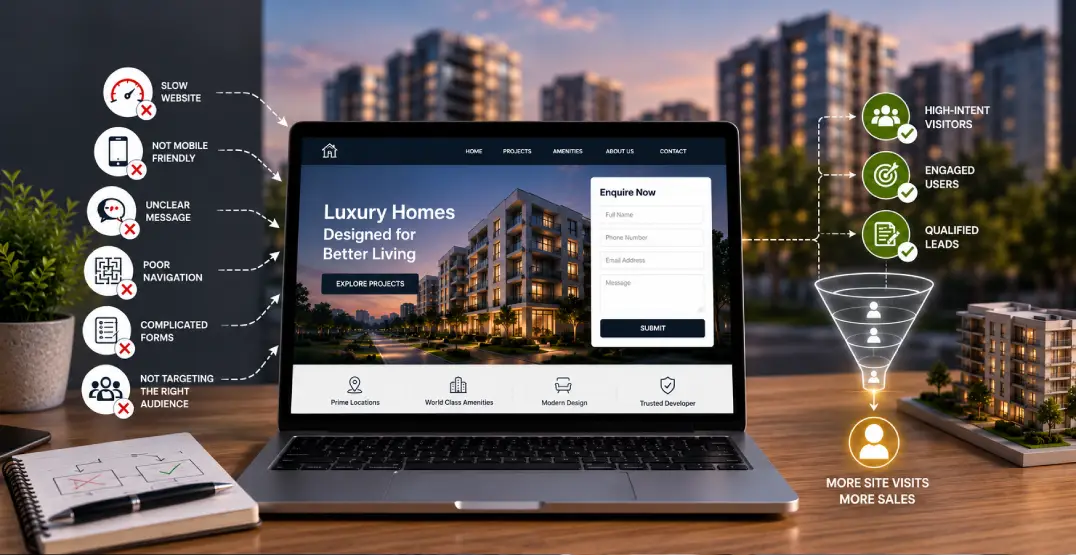
Your real estate website gets traffic. Your ads are running. Your SEO is bringing visitors. Yet the enquiries are still too few—or worse, they're not the buyers you actually want.
At Abstract Digital World , we see this challenge often. Real estate businesses invest heavily in websites, SEO and paid campaigns, but the website itself can become the missing link between traffic and qualified leads.
A website may look premium and still fail to convert. Slow pages, confusing navigation, weak CTAs, generic landing pages and incomplete project information can quietly push potential buyers away.
So, what is going wrong?
Here are 10 common reasons your real estate website may not be generating qualified leads and how ADW's approach to SEO, UX, CRO and lead generation can help fix them.
1. Poor Real Estate Website Design Creates Friction
A website can look premium and still make buyers work too hard.
Think about what a property buyer wants to know: What configurations are available? What is the carpet area? What does the project cost? Where is it located? Can they see the floor plan?
If those answers are difficult to find, interest can disappear quickly.
Mobile experience matters just as much. Small buttons, confusing menus, cluttered layouts or buried CTAs can create friction at exactly the wrong moment.
At ADW, real estate website design starts with the buyer journey:
Discover → Explore → Evaluate → Enquire
The goal isn't simply to make a website look good. It's to make every important step easier to take.
2. You're Attracting Traffic, But Not the Right Buyers
More traffic sounds good. But is it the right traffic?
Someone searching for “real estate investment tips” has very different intent from someone searching for “2 BHK flats in Kharghar under xx lacs
The second search tells you much more about what that person wants.
Your real estate website needs visitors who match the properties you're selling—based on location, configuration, budget and buying intent.
This is where ADW's search intent strategy becomes important. Instead of chasing traffic for its own sake, ADW connects keywords with the actual projects, locations and audiences a real estate business wants to reach.
Because 10,000 irrelevant visitors won't necessarily deliver what 100 relevant ones can.
3. Incomplete Property Pages Make Buyers Look Elsewhere
What happens when a potential buyer can't find the information they need?
They search somewhere else.
A project page should answer the questions buyers naturally ask before enquiring:
- Configuration and carpet area
- Pricing or starting price
- Floor plans
- Location and connectivity
- Amenities
- Possession details
- Developer information
- RERA details
- FAQs
- A clear enquiry option
When important information is missing, buyers have to leave your website to find answers.
ADW structures property content around buyer questions rather than simply listing developer information. The aim is simple: give visitors enough relevant information to evaluate the property and confidently take the next step.
4. A Slow Website Can Kill Intent Before It Becomes an Enquiry
You paid for the click. The visitor arrives.
Then the page takes too long to load.
What happens next?
They leave.
Real estate websites often rely on large images, videos and visual elements to showcase properties. But without proper optimization, those assets can slow the experience—especially on mobile.
At ADW, performance is treated as part of the conversion experience. Images, scripts and page elements need to support the visual quality of a real estate website without making visitors wait.
Because a beautiful website that loads too slowly can still lose the lead.
5. Your Landing Pages Aren't Built for Real Estate Lead Generation
Consider this journey:
Ad: 2 BHK Homes in Navi Mumbai from ₹XX Lakhs
Click → Developer Homepage → Multiple Projects → About Us → Contact
The visitor came looking for one property. Why make them search for it again?
A campaign landing page should continue the message that earned the click:
Ad → Matching Headline → Project Details → Proof → CTA
For real estate lead generation, ADW creates campaign-focused landing experiences aligned with the audience, project and campaign objective.
The visitor shouldn't have to figure out what to do next. The page should guide them there.
6. Generic CTAs Give Interested Buyers No Clear Next Step
“Contact Us” is familiar.
But is it always what a property buyer wants?
Not necessarily.
Someone researching a project may want a brochure. Someone comparing properties may want floor plans. A high-intent buyer may want pricing or availability.
Match the CTA to the visitor's intent:
- Researching: Download Project Brochure
- Comparing: View Floor Plans
- Interested: Get Project Pricing
- High Intent: Check Availability
- Ready to Visit: Schedule a Site Visit
At ADW, CTAs are treated as conversion points, not decorative buttons. The action should be specific, visible and relevant to what the visitor wants at that moment.
Don't make buyers guess what happens after they click.
7. Your Lead Forms Ask for Too Much, Too Soon
Imagine finding a property you're interested in and immediately being asked for your name, phone number, email, budget, occupation, location and purchase timeline.
Would you fill it out?
Maybe. Maybe not.
Every unnecessary field can create another reason to abandon the enquiry.
That doesn't mean removing qualification. It means asking for the information you actually need at that stage.
ADW focuses on low-friction, mobile-friendly lead capture, using shorter forms and appropriate alternatives such as calls or WhatsApp where relevant.
The objective is to make genuine enquiries easier without losing useful lead information.
8. Your Real Estate Website Isn't Being Continuously Optimized
Launching a website isn't the finish line.
It's the beginning of another set of questions.
Where are visitors dropping off? Which CTA gets more clicks? Are mobile users converting? Which pages generate enquiries? Which campaigns bring qualified prospects?
That's where real estate website optimization and CRO come in.
At ADW, the approach follows a simple cycle:
Analyse → Test → Learn → Improve
Headlines, layouts, forms, CTAs and landing pages can all be tested. Instead of relying on assumptions, user behaviour can show you what needs to change.
Because a website shouldn't stay the same while your audience keeps changing.
9. Your Website Isn't Building Enough Trust
A property isn't an impulse purchase.
Before sharing their details, buyers want confidence in the project, developer and information they're seeing.
Your website can build that confidence through:
- RERA information
- Developer credentials
- Authentic project visuals
- Construction updates
- Location details
- Testimonials
- Relevant documentation
- Transparent project information
These trust signals can directly influence property website conversion because buyers are more likely to enquire when the information feels credible.
ADW integrates trust signals into the user journey so visitors encounter reasons to believe in the project before they're asked to take action.
10. You're Measuring Traffic Instead of Qualified Leads
Here's the uncomfortable question:
What does 50,000 monthly visitors mean if they don't become enquiries?
Traffic, impressions and clicks are useful. But they aren't the final objective.
A real estate business should also ask:
- How many enquiries came in?
- How many were qualified?
- Which campaign generated them?
- How many requested a site visit?
- Which pages are converted best?
- Which source produced the strongest leads?
A good real estate marketing agency needs to look beyond vanity metrics.
This is where ADW connects website activity with business outcomes helping identify which pages, campaigns and conversion points contribute to qualified opportunities.
How Abstract Digital World brings all together
A high-performing real estate website needs more than attractive design or good SEO.
It needs every part of the digital journey to work together.
01 — ATTRACT
SEO + Search Intent
Bring relevant property buyers to the website.
02 — ENGAGE
UX + Speed
Give visitors a fast, intuitive experience.
03 — INFORM
Property Content
Answer the questions that influence their decision.
04 — FOCUS
Landing Pages
Match campaigns with relevant experiences.
05 — CONVERT
CTAs + Forms
Make the next action clear and easy.
06 — IMPROVE
CRO + Analytics
Use actual user behaviour to improve performance.
Conclusion: Build a Website That Converts
Your real estate website should do more than showcase properties.
It should attract the right audience, answer their questions, build confidence and make taking the next step simple.
At Abstract Digital World The focus goes beyond getting more people to your website. It's about creating a digital experience that turns relevant attention into meaningful action.
Because more traffic isn't always the answer.
Better traffic. Better experience. Better conversion. Better leads.
That's what a real estate website should ultimately deliver.
Ready to grow your revenue?