

SEO vs Paid Ads for Real Estate: Which Generates Better ROI?
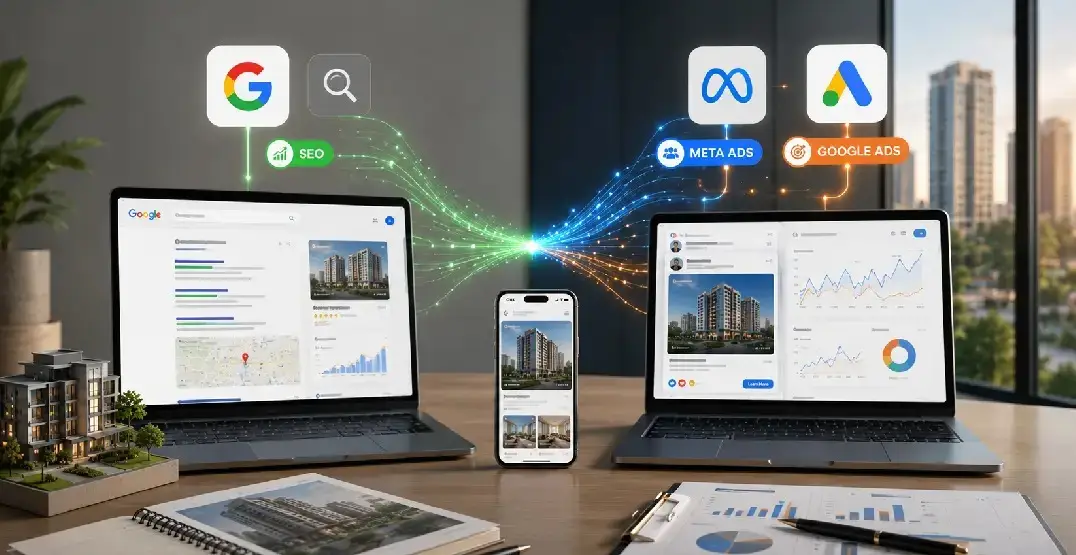
Imagine a developer who has just finished a flagship project. The architecture is iconic and the location is prime, but there is one major problem: when a buyer searches for a similar property query , but property is not ranked in google first SERP.
Most sites fail because they act like silent digital brochures stunning to look at, but invisible to search engines. The only way to break this silence is through strategic on page SEO real estate. This blog provides a complete real estate website SEO checklist to help you bridge that gap, turning "ghost" pages into ranking assets that finally attract high-intent buyers.
Real Estate SEO vs PPC — Understanding the Core Difference
Think of SEO as "buying land" and PPC as "renting a billboard." Real estate SEO vs PPC is a battle of ownership. SEO builds organic authority over months; once you rank, you own that digital territory. It’s a long-term "moat" for your brand.
Conversely, PPC is a faucet traffic flows instantly but vanishes the moment you stop paying. While PPC offers speed, SEO provides a "trust factor." In 2026, savvy Indian buyers often skip "Sponsored" tags for organic results, perceiving those developers as more established.
SEO for Real Estate Agents — How Organic Traffic Brings Consistent Enquiries
Organic search is the foundation of sustained brand growth. SEO for real estate agents isn't just about keyword stuffing, it's about linking the buyer's journey with content. By creating micro-location guides such as "The Future of Kharghar" you can capture potential buyers during the initial research phase.
The real value builds over time. Unlike ads with fixed lead costs, your blog made on the project now can generate enquiries in 2028 for free. Using Google Search Console, you can answer specific intent like "RERA-approved projects in Thane" turning simple clicks into pre-sold leads.
PPC for Real Estate Leads — Immediate Results and Lead Quality
When a project launch is days away, SEO is too slow; you need PPC for real estate leads. With Google Ads, you can reach buyers very precisely based on their location and budget.
But there’s a clear difference between paid ads and organic traffic when it comes to real estate leads. PPC leads usually show strong intent, but they’re also easily distracted; they often click on multiple ads at the same time. That’s why your sales team needs to respond quickly to capture their attention. Conversely, organic leads are more "educated," having built trust through your content before ever hitting "Enquire Now."
Cost Per Lead Real Estate Marketing — The ROI Breakdown
Let’s talk about the math that keeps developers up at night. In the Indian market, the cost per lead real estate marketing is a tale of two very different curves.
The PPC Curve:
In competitive hubs like Mumbai or Bangalore, a high-quality Google Ads lead can cost anywhere from ₹1,200 to ₹3,000. This is a linear cost. If you want 100 leads, you must pay the full price for 100 leads. It’s predictable but expensive.
The SEO Curve:
Initially your cost per lead for SEO isn't exactly appealing. You're paying for technical fixes, content and backlink development, yet receiving no leads for those first few days. But as your authority increases your traffic grows, and your costs remain unchanged. At the end of month 12 your CPL will drop dramatically and can be the range of Rs150 to 400.
From an ROI standpoint, SEO is the clear winner in the long run for longevity. It eliminates all "dependency risk" where your excitement about your project ends when you stop generating ad campaigns
The Ideal Combined Strategy — When to Use Each
The most successful real estate brands in 2026 don't choose between real estate SEO vs PPC; they use both as part of a "Full-Funnel" strategy.
- Use PPC for Sprints: Deploy Google Ads for new project launches, clearance of unsold inventory, or time-sensitive festive offers (like "Navratri Special" discounts). It’s perfect for creating a buzz when the clock is ticking.
- Use SEO for the Marathon: Invest in organic content to dominate your local micro-markets and build brand authority. If you want to be the "go-to" name for property in Kalyan or Thane, you need to own the organic search results for those areas.
A pro tip: Use your PPC data to inform your SEO. If you find that a specific keyword like "Luxury 3BHK with Deck" is converting like crazy in your paid ads, that’s your signal to write a massive, 2,000-word organic guide on that exact topic.
Timeline of Results and Performance Tracking
Managing expectations is key. In the first 30 days, PPC is your only source of life. You’ll see leads within hours of the campaign going live. SEO, meanwhile, is in the starting phase. By day 120, the scales start to tilt. This is the maturity curve where SEO traffic begins to climb, often allowing you to reduce your "aggressive" PPC bidding on expensive broad terms because you now rank #1 for them naturally.
To track this effectively, you must be proficient with the trifecta of tools: Google Analytics (GA4) to track user behavior, Google Search Console to monitor organic health, and the Google Ads Dashboard to keep a hawk-eye on your daily CPL.
So, what should you prioritize? If your sales gallery is empty and you need walk-ins tomorrow, start with PPC for real estate leads. It provides the immediate boosts your business needs. However, if you want to build your project online presence gradually without spending money due to rising ad costs, you must start your real estate SEO journey today.
The highest ROI always comes from a balanced approach: use PPC for the immediate leads and turn them into conversion and SEO to build a digital empire that lasts for decades.
FAQs
Q1. Why is SEO considered better for trust than PPC?
Buyers in 2026 know that anyone can pay for an ad, but only a credible, authoritative brand can rank #1 on Google for a long period. Organic rankings act as a "third-party endorsement" from Google itself.
Q2. How long does it take for a real estate blog to rank?
Depending on the competition, a well-optimized blog can take anywhere from 3 to 6 months to hit the first page. However, once it ranks, it can stay there for years with minimal maintenance.
Q3. Can I run PPC and SEO for the same keywords?
Yes, and you should! This is called "Search Engine Dominance." By appearing in both the paid and organic sections, you increase your click-through rate and prevent competitors from stealing your traffic.
Q4. What is the biggest mistake developers make with SEO?
The biggest mistake is quitting too early. SEO is a marathon; most developers stop investing in month 3, right before the exponential growth begins in month 6.
Ready to grow your revenue?